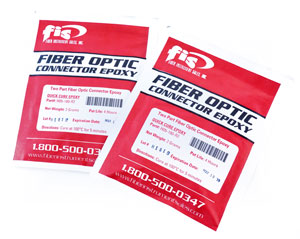
Fiber Optic Connector Epoxy
Which is the Best Application?
Follow Recommendations
Depending on their specific chemical compositions, there are a number of fiber optic connector epoxies on the market that offer a range of curing options. All of these fiber optic connector epoxies require that manufacturer recommendations be followed explicitly, particularly in regard to curing time.
Epoxy Formulations
In creating and evaluating their fiber optic epoxy formulations, manufacturers rely on a number of tests and measurements that may include Differential Scanning Calo-rimetry (DSC), Thermogravimetric Analysis (TGA), Storage Modulus, Coefficient of Thermal Expansion (CTE), and Glass Transition Temperature (T/sub g/).
Epoxy Curing Schedules
Fiber optic connector epoxy curing schedules are created in large part to minimize curing oven temperature gradients and to achieve uniform T/sub g/, which minimizes out gassing and lessens the degree to which pistoning can occur within the ferrule.

Deviating from Fiber Optic Epoxy Cure Schedules
• To speed curing time, some installers have begun using fiber optic connector curing ovens designed for "hot-melt" style fiber optic connectors, which operate at temperatures that are 100 to 200 degrees higher than those of epoxy connector curing ovens. This practice violates the epoxy manufacturer's curing instructions and can cause a multitude of problems. These problems range from degraded fiber optic connector performance to complete failure of the optical connection.
• If fiber optic connector epoxy is cured too quickly, this can result in out gassing that can cause the connector epoxy to expand to the extent that it cracks the optical fiber.
• Sometimes these cracks are apparent once the fiber optic connector end-face is inspected under a fiber optic inspection micro-scope. However, the fracture may be located far enough from the fiber optic connector end-face where it cannot be seen. Even the smallest core fractures will impede optical performance and have the tendency to "grow" into larger fractures over time.
• Conversely, improper curing of a fiber optic epoxy connector can sometimes cause epoxy to shrink. This can stress the optical fiber and/or weaken the bond between the optical fiber and the ferrule within the fiber optic connector. • Stress fractures are more likely to occur with multimode optical fiber. Singlemode optical fiber is more compressed than multi-mode fiber and therefore better able to withstand such stress.
• Besides fractures, improper curing can weaken the bond between the optical fiber and the fiber optic connector ferrule. Once in-stalled, the optical fiber may begin to piston within the ferrule. This will degrade the signal at the interface between the two con-nected optical fibers, or it may cause a total optical disconnect within the fiber optic connector.
Heat Cure vs. Room Cure Connector Epoxy
When using an epoxy style fiber optic connector, one must decide which type of fiber optic connector epoxy is preferable for the task at hand, Namely a "heat cure" epoxy or a "room cure" epoxy. The following are some advantages and disadvantages of both.
Heat Cure Fiber Optic Connector Epoxy
• Heat Cure fiber optic connector epoxies require that connectors be placed in an epoxy curing oven and heated for a period of time at temperatures that range between 212°F - 302°F. In contrast, Room Cure fiber optic connector epoxies are designed to cure at normal room temperatures without requiring the use of an epoxy curing oven.
• Advantages of heat cure fiber optic connector epoxies have a relatively fast cure time. Depending on the chemical formulation of a particular heat cure epoxy, these connector epoxies typically cure within 15-30 minutes. One advantage of this short cure time is that there is less chance of the optical fiber being disturbed while it is being cured. Finally, heat cure fiber optic connector epox-ies generally have a long pot life of up to 4 hrs. or more. "Pot life" in this example is the time period over which epoxy remains workable in an open container.
• Disadvantages of heat cure fiber optic connector epoxies must be cured in an electric heating oven, which should not be used in environments where combustible fumes may be present. Also, a fiber optic connector heat oven cannot be used where AC power is not available. Because of their fast cure times, fiber optic heat cure epoxies have the potential to stress fiber, although this is.