

Fiber Optic Cable Menu




Know Which Fiber Optic Cable You Need?
Fiber Optic Cable Options
There are so many cable options available that one might wonder where to start. The following is a list of many of the different types of fiber optic cable and their specific uses.
Multimode or Singlemode Fiber Optic Cable?
Singlemode Fiber Optic Cable
Single mode is a type of optical fiber that is designed for the transmission of a single ray or mode of light as a carrier and is used for long-distance signal transmission needed in the CATV, Telecommunications and Cellular industries. Single mode fibers use high powered LASER (Light Amplification of the Stimulated Emission of Radiation) light sources in the infrared spectrum.
Multimode Fiber Optic Cable
Multimode fiber optic cable is typically used in short distance transmissions such as LANs (Local Area Networks), camera operations and short building to building or floor to floor applications. Multimode popularity comes from its less expensive (compared to singlemode) light sources. Originally LEDs (Light Emitting Diodes) were used to reduce the cost of network equipment, but later VCSEL (Vertical Cavity Surface Emitting LASER) light sources replaced LEDs in higher speed networks. LED light sources are only capable of transmission speeds up to 620Mbps, with the introduction of 1Gbps, 10Gbps and 40Gbps Ethernet LEDs became obsolete and were replaced with VCSELs. The original FDDI standard of multimode has been replaced with LASER optimized (LOMMF) OM1, OM2, OM3 and OM4 standards. OM5 standard multimode is now being produced to support 40 and 100Gbps networks by using short wave division multiplexing (SWDM).
Fiber Optic Cable Applications:
Multimode fiber is used to transport high volumes of data over relatively short distances (compared to single mode fiber). Common applications include Data Centers and other Local Area Network (LAN) applications. Note that multimode distance capabilities have increased over the years. Multimode cable offers an economical alternative to single mode cable for certain applications.
Fiber Optic Cable Design:
Multimode cable has a relatively large core (most commonly either 50µm or 62.5µm) that enables multiple streams of data to be transported simultaneously.
Characteristics of Singlemode Fiber Optic Cable:
- Most common wavelengths used in single mode fiber optic cable are: 1310nm,1550nm,1490nm, 1625nm.
- Attenuation values are: 1310nm = 0.3 dB/km, 1550nm = 0.2 dB/km, 1490nm = 0.24 dB/km, 1625nm =0.22 dB/km.
- Fiber Jacket color: yellow.
Fiber Optic Cable Applications:
Telcos and CATV companies use single mode cable to transport signals over long distances. Business campuses and other institutions also use single mode cable for longer cable runs, such as links between buildings.
Fiber Optic Cable Design:
The core diameter of single mode fiber is so small (9µm) that it permits only one mode of light to pass through it at any given time. This characteristic reduces attenuation and enables light to be transmitted over great distances.
Characteristics of Multimode Fiber Optic Cable:
- Common wavelengths used in multimode fiber cable are: 850nm and 1300nm
- Attenuation values are: 850nm = 3 dB/km, 1300nm = 0.7 dB/km
- Fiber Jacket color: Orange – OM1 and OM2 (Typical); Aqua – OM3 (Typical); Aqua – OM4 North America; Magenta OM4 (Europe); Lime Green – OM5
Cable Configurations
- Single Fiber Construction - Simplex
- Two-Fiber Construction - Duplex
- Multi-Fiber Construction
1. Breakout Fiber Optic Cable Components: (Indoor Use Only)
- PVC (Polyvinyl Chloride) Outer Jacket
- PVC (Polyvinyl Chloride) Inner Jacket (Typically 2.5mm)
- Aramid Yarn (Kevlar® by DuPont)
- 900um PVC (Polyvinyl Chloride) Tight Buffer
- Bare Fiber(s) (Core, Cladding, 250um Ultraviolet Cured Acrylate Buffer)
2. Distribution Fiber Optic Cable Components: (Indoor Use Only)
- PVC (Polyvinyl Chloride) Outer Jacket
- Aramid Yarn (Kevlar® by DuPont)
- PVC (Polyvinyl Chloride) Fiber Optic Subunit
- Color Coded Bare Fiber(s) (Core, Cladding, 250um Ultraviolet Cured Acrylate Buffer)
3. Micro-Distribution Fiber Cable Components: (Indoor Use Only)
- PVC (Polyvinyl Chloride) Outer Jacket
- Aramid Yarn (Kevlar® by DuPont)
- PVC (Polyvinyl Chloride) Fiber Optic Subunit
- Color Coded Bare Fiber(s) (Core, Cladding, 250um Ultraviolet Cured Acrylate Buffer)
4. Loose Tube (Gel Filled) Fiber Optic Cable (Outdoor Use)*
- Polyethylene Outer Jacket
- Aramid Yarn (Kevlar® by DuPont)
- Fiber Optic Subunit with Water Blocking Gel (Icky Pic)
- Color Coded Bare Fiber(s) (Core, Cladding, 250um Ultraviolet Cured Acrylate Buffer)
- * Allowed up to 50 feet indoor use per US fire codes
5. Indoor/Outdoor Cable
6. Ribbon Fiber Optic Cable
- PVC (Polyvinyl Chloride) Outer Jacket
- Aramid Yarn (Kevlar® by DuPont)
- Ribbon Matrix (Glue) Binder
- Color Coded Bare Fiber (Core, Cladding, 250um Ultraviolet Cured Acrylate Buffer)
7. Specialty Ribbon Cable
A) AFL SpiderWeb Ribbon Cable (SWR®)
SpiderWeb Ribbon (SWR®) consists of 12 fibers that are connected to each other by an intermittent UV-curable resin bond. The intermittent nature of the bond allows the ribbon to be bunched and collapsed like a bundle of loose fibers. It further lets the ribbon act as either a traditional ribbon for mass fusion splicing or be broken out into individual fibers for single fusion splicing.
B) OFS Rollable Fiber
OFS Rollable Ribbon High Density Fiber Optic Cables are smaller and lighter in weight than standard flat ribbon cables. At the same time, these cables allow installers to double the density of vital pathways versus standard cable designs. These cables were created by partially bonding single 250μm fibers to each other to form a bendable high density fiber cable. This design allows for a highly efficient ribbon splicing and easy single or multiple fiber breakout.
C) Sumitomo Freeform Ribbon
Sumitomo Electric Lightwave’s Freeform Ribbon™ allows for dense fiber packing and a small cable diameter with a non-preferential bend axis thereby increasing density in space-constrained applications. Sumitomo Electric’s patented, pliable Freeform Ribbon™ construction is designed to pack densely in small form factor cables while still being capable to transform quickly, by hand ONLY, to splice-ready form similar to standard ribbon
8. Armored/Ruggedized Jacketed Fiber Optic Cable (Indoor or Outdoor Use)
A) Aluminum Interlocking Cable
- Aluminum Interlocking Armor
- PVC (Polyvinyl Chloride) Outer Jacket
- Flame Rated - Riser or Plenum
- Rodent Protection
B) Corrugated Steel Tape Fiber Optic Cable
- Ultimate Environmental Protection
- Rodent Protection
- Corrugated Steel Tape Armor
- Direct Burial
9. Drop Cable (Outdoor Use)
A) Round Drop Cable
- PVC (Polyvinyl Chloride) Outer Jacket for MDU Applications, Polyethylene for Indoor/Outdoor Applications
- Run from Distribution Point to Subscriber’s Location
B) Flat Drop Cable
- Polyethylene Outer Jacket
- Run from Distribution Point to Subscriber’s Location
C) Aerial Drop Cable
- Polyethylene Outer Jacket
- Outside Installation on Poles
10. Tactical Fiber Optic Cable
- Rated for Tough Outdoor Use
- Outside Plant Applications
- Re-deployable
- High Crush Resistance
11. Optical Ground Wire (OPGW)
- Optical Fibers are Surrounded by Layers of Steel and Aluminum
- Used in Overhead Power Lines
- Provides Functions of Grounding & Communications
Simplex or Duplex Fiber Optic Cable?
Fiber Optic Cable Applications:
Simplex and Duplex cables are typically used for patch cables and desktop installations that don't require a high fiber count.
Simplex Fiber Optic Cable
Fiber Optic Cable Design:
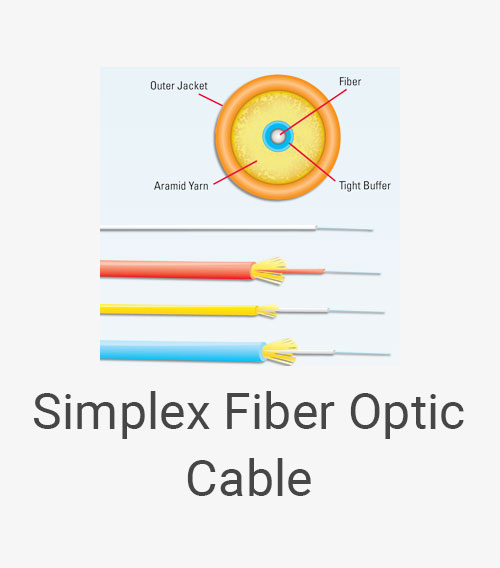
Simplex cables contain a single 900µm tight buffered fiber surrounded by aramid yarn strength members with an outer jacket diameter varying from 3mm to 1.2mm.
Duplex Fiber Optic Cable
Fiber Optic Cable Design:
Duplex cables contain two 900µm coated fibers surrounded by aramid yarn strength members with an outer jacket diameter varying from 3mm to 1.2mm.

Simplex Fiber Optic Cable
This is a cable structure with a single fiber. Simplex Cable varieties most commonly include 1.6mm, 2mm and 3mm outer jacket sizes.

Duplex Fiber Optic Cable
This cable contains two optical fibers in a single cable structure. Typically, one fiber is used to transmit signals and the other receives.
Loose Tube or Tight Buffer Fiber Optic Cable?
Loose Tube Fiber Optic Cable
Fiber Optic Cable Applications:
Loose tube cable is ideal for use in long distance outside plant applications that require a high fiber count. The cable is designed to withstand harsh outdoor environments. The cable's unjacketed bare fibers are free to expand and contract with temperature changes.
Fiber Optic Cable Design:
Fibers within loose tube cables are surrounded by a water blocking component (either gel or a dry water-blocking material). Although loose tube cables are engineered to withstand damp outdoor environments, they are not designed to be submerged in water, but they can come in contact with water.
Terminating Loose Tube Fibers:
Fibers within gel-filled tube cable have a very thin acrylate coating usually about 250µm in diameter. Before terminating, the fibers must be put into small plastic tubes (called a breakout kit or fan out kit). The tubes protect the thin fibers and make them easier to handle when terminating and connecting to network equipment...
Tight Buffer Fiber Optic Cable
Fiber Optic Cable Applications:
Tight buffer cable is typically used indoors. A tight buffer PVC jacket encapsulates each fiber. The buffer enables the fibers to be directly terminated without requiring a breakout kit, which saves substantial time.
Fiber Optic Cable Design:
The fibers in tight buffer cables have two protective coatings; an acrylate coating over the fiber and a PVC tight buffer jacket over the coated fiber.

Loose Tube Cable
Tube encloses multiple coated fibers that are surrounded by a gel compound that protects the cable from moisture in outside environments. Cable is restricted from indoor use, typically allowing entry inside a building not to exceed 50 feet.
Distribution or Breakout Fiber Optic Cable?
Distribution Fiber Optic Cable
Fiber Optic Cable Applications:
Distribution cable is ideal for networks that terminate multiple fibers at a common location, such as a patch panel or communications closet. Unlike breakout cable, individual fibers within a distribution cable don't have their own aramid strength members. This space-saving feature enables as many as 288 tight buffered fibers to be bundled within the cable. "Micro Distribution" cable has color coded bare fibers and may contain up to 576 or more fibers. A disadvantage of micro-distribution cable is that the unjacketed fibers require the use of a breakout kit for termination.
Fiber Optic Cable Design:
Distribution cables contain a number of 250µm - 900µm fibers that are color coded for easy identification. The cable includes aramid yarn strength members and a thick outer jacket that provides protection and strength during cable installation. If required, the cables can be purchased with interlocking armor.
Breakout Fiber Optic Cable
Fiber Optic Cable Applications:
Breakout cable is ideal for applications where fibers are connected directly to equipment, including local hubs. Also, the robust design of breakout cable makes them well suited for use as drop cables.
Fiber Optic Cable Design:
Breakout cable differs from distribution cable in that each of the tight buffered fibers in a breakout cable have their own aramid yarn strength members and a 2 or 3mm jacket to enclose the tight buffered fiber and aramid yarn. They can be terminated without requiring a breakout kit. This can save substantial time and installation costs.
One disadvantage of breakout cable is that the individual fiber jackets take up room within the cable, so breakout cable cannot contain as many fibers as distribution cable. Fiber counts for breakout cable are typically 2-24 fibers (maximum is 48 fibers).

Distribution Fiber Optic Cable
This compact building cable consists of individual 900um buffered fibers. It is smaller in size and costs less than breakout cable. Connectors may be installed directly on 900um buffered fiber at breakout box location.

Fiber Optic Breakout Cable
This cable consists of multiple simplex jacketed fibers contained within an outer jacket. Breakout cable enables the quick installation of connectors on to 2 or 3mm robust jacketed fiber.
Plenum or Riser Fiber Optic Cable?
Plenum-Rated Fiber Optic Cable
A plenum is a pathway used for circulating air within a building. Plenum Cable (OFNP) has a fire rating that allows it to be routed through a plenum.
Riser-Rated Fiber Optic Cable
Riser Cable (OFNR) may be run between floors but NOT through a plenum.
LSZH Fiber Optic Cables
Low Smoke Zero Halogen (LSZH) cables produce minimal smoke or hazardous halogen compounds when burned.
Final Considerations When Choosing Fiber Optic Cable
Identify your cable pathways before ordering cable. This will enable you to determine the length of the cables you need as well as the degree of physical protection the cables will require. Note that newer bend-insensitive optical fibers enable fiber optic cable to negotiate tight turns with little or no decrease in signal propagation. This new type of fiber greatly expands your cable path options.
It is highly recommended that you "future proof" your network by ordering cables that have a higher fiber count than you currently require. Optical fibers are relatively inexpensive compared to the cost of installing them at a future date.
Finally, whether you already know the exact type of cable you require or still have some questions, our specially trained technical experts can assist you. Need something special? You can indicate all of the cable features you need and we will provide cables built to your specifications.
Contact us today. We can assist you.
info@fiberinstrumentsales.com or 1 800 5000 FIS (347)