


SUPERIOR TECHNOLOGY PROVEN RELIABILITY EXTRAORDINARY SERVICE
Backed by the best team in the world.
You've Got Questions. We Have the Answers. Our people are experts in fiber optic splicers.
AFL Fujikura FUSION SPLICERS
AFL Fujikura is a pioneer in the fusion splicer industry. For over 30 years AFL is the leader in optical fiber splicing technology and product value. As early as 1984, AFL's technology lead the way in fiber alignment. Their Profile Alignment Splicing technology quickly emerged as the industry preferred alignment methodology. Just 4 short years later in 1988, AFL developed the first ribbon splicer. Not resting on their laurels, they forged ahead and introduced the first 24-fiber ribbon splicer. An industry first. AFL Fujikura continued to set the pace in the fiber optic business by designing their "split v-groove" clamping system for which they hold a patent. Further innovation assures AFL remains a leader.
AFL Fujikura SPLICER PARTS
Fiber Holders- Genuine AFL Fujikura holders are must when you want to get the best from your splicer. After market holders could cause an issue. Why take a chance on your expensive fiber installation?
Electrodes' Electrodes break down over normal use and must be replaced. Why purchase a quality piece of equipment and then in-stall after market parts that can cause a problem? Good electrodes can make the difference between an excellent fusion and one that causes excessive attenuation. It doesn't make sense to take the chance to save a few dollars.
HOW DOES FUSION SPLICING WORK?
It's really quite simple. Heat is applied to fuse fiber optic cable. A fusion splicer uses an electrical arc which melts two pieces of optical fiber to form one continuous piece of fiber. When the splicing done correctly the fusion splice will minimize back reflections which is the light that is reflected back to the source after it encounters an imperfection in the fiber. There are 5 simple steps that must be adhered to. First of all, the fiber must remain clean during this process. The optical fiber needs to have everything removed until only the fibers are visible. Next, the fiber must be cleaved. A special cleaving tool must be used for this process. In this step the cleave on each fiber must be perpendicular. A fusion splicer is then used for the next step. This is where the electrical arc from the fusion splicer melts the two ends into one continuous fiber. Finally, the splice itself must be protected against breakage. This is done by placing a protective sleeve over the exact splice location. Finally the fiber should then be tested for end to end loss.

The latest in fusion splicing technology is here!
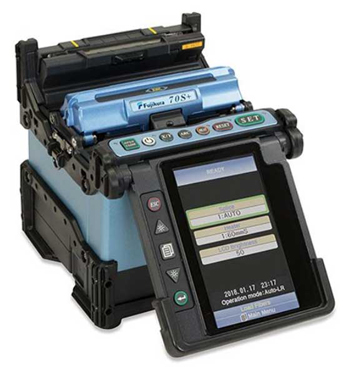
The AFL Fujikura 70S+. It has Bluetooth wireless communication, automated & programmable wind protector which expedites the splicing process. It's fast,. It has a 13 second automated tube heater for a total splice time of only 21 seconds!