

Minimizing ORL in Fiber Optic Links
FIS CPRI Interface Panels are simply better for the optical network
Many CPRI interface panels will be utilized at the monitor port by a CPRI Analyzer to troubleshoot the RAN. They provide important access to the raw CPRI data on the receive path of the UPLINK, as the RRHs are not always easily accessible. CPRI interface panels are inserted into the fiber optic network link between the transmitter and receiver, often referred to as a SFP (Small Form-Factor Pluggable). In evaluating a fiber optic link, both attenuation and Optical Return Loss (ORL) or ‘back reflection’ will continue to surface as a concern when ensuring performance is at its best. Low attenuation and ORL are critical to sustain high bandwidth and data transfer rates between the SFPs. Fiber Instrument Sales recognizes these two important criteria, attenuation and ORL, when designing their CPRI interface panels for use within a fiber optic link. Choosing FIS CPRI interface panels is simply healthier and better for the network compared to some alternative suppliers.
In calculating a loss budget and reviewing test data on an optical link, the user can calculate attenuation and ORL estimates of common passive optical components such as cable, patch cables, mating sleeves and splitters. Fiber Instrument Sales combines these components within a CPRI interface panel and documents the test data criteria to ensure losses adhere to industry specifications and polarity is correct.
• But how do these passive optical components perform when dropped into an optical network?
• Does the manufacturer truly understand characteristics of the fiber optic link and its components?
• How do you ensure your team has the technical support required to make the network its best?
When the speed of the network is required to reach new thresholds, owners may again have to review attenuation and ORL values. It may often be found that a particular component will be in need of improvement. When high bandwidth media services such as video are in discussion, reducing high ORL is historically approached as the first step in improving the optical link.
While working with technicians in the field, test equipment manufacturers of OTDRs have recognized the superior ORL measurements achieved when using FIS CPRI interface panels over alternative CPRI panel suppliers. This is in part due to the high quality components installed in FIS CPRI interface panels and modules.
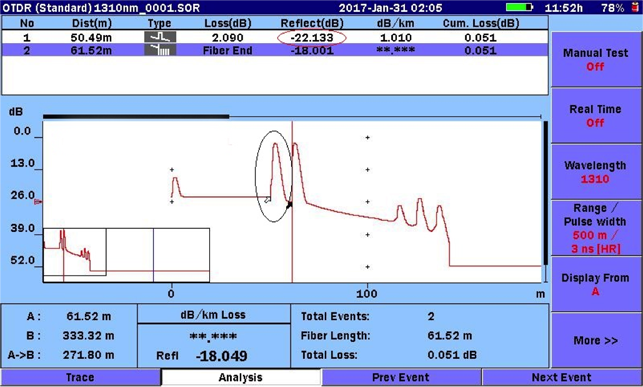
A. Example of an OTDR test of CPRI module with high reflective event equating to poor system ORL.
ORL levels in the network are verifiable by completing an OTDR test with two optical launch cables. First, verify all optical ports are clean and the end faces of the launch cable connectors are clean. Second, connect the launch cable to the OTDR, with the opposite LC connector plugged into the input channel of RRH or BBU. Then insert the second launch cable to the corresponding output port, which continues the link to what would be the BBU or RRH. The objective is to test a complete transmit path through the CPRI interface panel. This identifies the potential attenuation within the link, and more importantly identifies the effect that the CPRI interface panel has on ORL within the optical network.
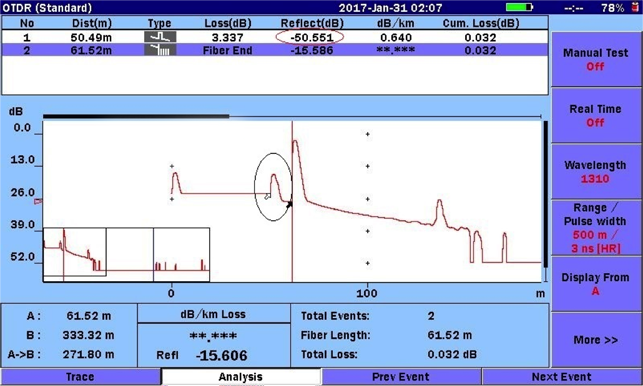
B. Example of an OTDR test of CPRI module with minimal reflective event equating to good system ORL.
This test displays poor system ORL as the result of components utilized within the packaged CPRI panel. A 50mtr launch cable is in the RRH transmit path and a 15mtr launch cable is in the BBU receive path. The last reflective event before drop off is an open ended LC/UPC connector.
This test displays good system ORL as the result of strong optical components installed within the FIS CPRI panel. A 50mtr launch cable is in the RRH transmit path and a 15mtr launch cable is in the BBU receive path. The last reflective event before drop off is open ended LC/UPC connector.
FIS has provided broadband splitters to the fiber optic industry for over 20 years and has serviced the fiber optic market of contractors, OEMs and Telco/CATV for over 30 years. Fiber optics is its focus and passion.
FIS has over (9) CPRI chassis and module solutions for Macro, Small Cell, In-building and CRAN environments.