Fusion Splicer & Cleaver – A Service & Calibration Team
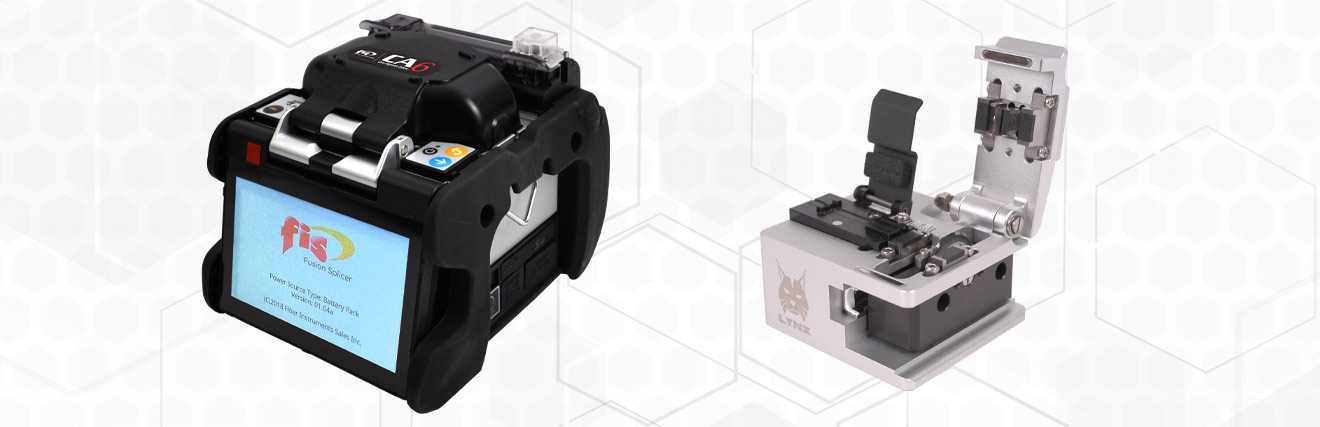
You Need to Have Maintenance and Calibration Conducted on both Your Splicer and Cleaver!
In the world of fiber optic calibration and maintenance, one of the most popular items to be serviced is the fusion splicer. Hands down what most would call one of the most important and used pieces of equipment in the fiber optic world. This tool literally connects us in the telecommunications industry, brings worlds together.
Now to be more specific, fusion splicing is the act of joining two optical fibers end-to-end. The goal is to fuse the two fibers together in such a way that light passing through the fibers is not scattered or reflected back by the splice, and so that the splice and the region surrounding it are almost as strong as the intact fiber. But did you know that this uber important piece of equipment does not run solo? It does not necessarily do all the work on its own… there is this little item that goes hand and hand with it, the precision cleaver. This little gem which is all too often not included in the service process. It is extremely important that it is included. Leaving this item out of your service process is not always a good move.
The success of the splice greatly relies on the condition and cleave angle of the fiber. You may be wondering what exactly is a precision cleaver…well the answer is that it is a small tool used to successfully cleave a piece of fiber. To get even more specific, a “cleave” is: A deliberate, controlled break, intended to create a perfectly flat end face, perpendicular to the longitudinal axis of the fiber. The process of cleaving an optical fiber forms one of the steps in the preparation for a fiber splice operation regardless of the subsequent splice being a fusion splice or a mechanical splice; the other steps in the preparation being those of stripping and fiber alignment.
A good cleave is required for a successful low loss splice of an optical fiber, often it is the case that fibers spliced by identical methods tend to have different losses, this difference can often be attributed to the quality of their initial cleaves. The general method of cleaving involves a general strategy known as the scribe-and-tension or scribe-and-break strategy. This strategy involves the introduction of a small crack into the fiber and the subsequent application of a tensile force in the vicinity of the crack that causes the fiber to cleave.
Now that you know what a splicer and cleaver are used for it should be stressed just how important it is that both of these tools work correctly. You may think you can service one or the other and ignore or put off one for a later date. I cannot highlight the importance of always servicing both of these tools together at the same time.
In the calibration world we often see reports of a fiber optic splicer not performing correctly or throwing numerous errors. When kits come in, our technicians find the splicer performing nearly flawless and the cleavers are in fact what are causing all the issues. Turns out the splicer operators in the field are producing poor cleaves and then the fiber optic splicer starts recognizing them and then begin throwing the errors. This happens so very often we see it almost weekly in our lab. Long story short folks…cleavers need love too!
Precision cleavers have a great deal of components that all need to be finely tuned and working together in sync. There are rollers, springs, bearings, slides, pads, trash bins and the blade. Just like anything else that has mechanical movement there is wear. Moving parts over time will break down. The precision cleaver has come a long way and the advancements have made them last even longer. New units are shock proof, easier to use, improved blade technology and auto rotating features offer the user a more reliable tool. The new blades in these cleavers are pushing a life span of 60,000 cleaves! But as you know, despite all that technology and advancements they need some attention and care. Cleavers wear out in several ways. The blades dull, slides and bearings ware out, settings get thrown out of spec and pads wear out. These small but important units get bumped around and beat up. This will absolutely cause issues for you in the field and we all know that is not where you want to find out.
When a cleaver is what you could say, out of whack, it will not score the glass properly. Fun fact: Cleavers do not cut, they score the glass. It’s kind of a little known fact about this great tool.
You want that glass to have a perfectly flat end face without chips, breaks, other issues causing reflectance. Now a splicer will often still fuse the fibers together despite the end faces not being perfect. You may think this is ok. However, there can be some hidden problems inside that splice. To insure you are not facing any obstacles in the splicer you may need to test the fiber using an OTDR. That is a whole other discussion we can have at a later time but for now let’s focus on the splicing & cleaving.
I like to say, not ensuring your cleaver is performing to factory specs is like putting in old expired gasoline in your new car… you just wouldn’t do it! So, you do not want to use a bad cleaver alongside your beautiful high performance splicer.
Remember to never leave those all important helpers at home when you send in your splicer for maintenance. We highly recommend you always keep the cleaver and your splicer together during and through the maintenance / service process. Ensuring these two units work jointly and properly will provide the most successful splices in the field. Not servicing them together can cause you downtime and we all know what that means… trouble / lack of income / delays / loss of work…you name it. So next time you think about sending in your splicer always remember to add your cleaver in to be serviced as well.